
 By
By 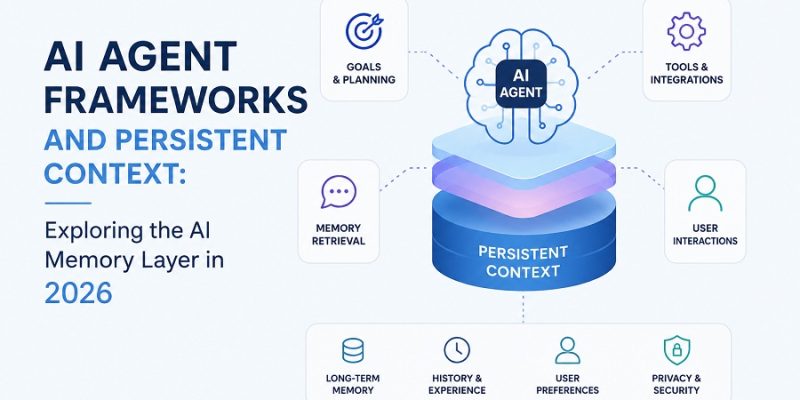
Pick any two AI agent frameworks in 2026 and the orchestration looks remarkably similar. Graphs, handoffs, role-based crews, tool calling, human-in-the-loop checkpoints. The wiring has largely converged. The thing that actually separates a weekend prototype from an agent people trust in production is not how it routes a task. It is whether the agent remembers anything once the task is over.
Orchestration is mostly a solved problem
By now the major frameworks have settled into recognizable shapes. LangGraph models work as a directed graph and quietly overtook CrewAI on adoption among enterprise teams. CrewAI leans on role-based crews. Microsoft folded AutoGen and Semantic Kernel into a single Agent Framework. Google’s ADK runs a hierarchy of agents that can talk to each other through the A2A protocol, while MCP has become the common way agents reach tools and data. Real differences remain, but for most teams comparing AI agent frameworks, the orchestration question is close to answered.
Persistent context is the actual gap
Here is the part the comparison charts undersell. Almost every framework still treats the context window as the agent’s memory, and that window gets wiped at the end of every run. So the agent forgets. A research agent re-summarizes a document it already read last week. A support agent asks a returning customer for details they gave on the very first call. These are not model failures. They are memory failures, and no amount of clever orchestration patches them.
What the memory layer actually does
This is why a dedicated memory layer has grown into its own category sitting alongside AI agent frameworks rather than a feature buried inside one. The pattern is consistent. Split memory into two tiers: ephemeral working memory that lives in the context window, and durable long-term storage that sits in a database, a vector index, or a knowledge graph. Important facts get written at the end of a session and pulled back in at the start of the next one. More mature setups tag every memory with a scope, so a user fact persists across sessions while a task fact stays tied to a single run, and retrieval composes the right slice on demand.
Why this is the story of 2026
The shift shows up in the numbers. One 2026 survey found dedicated memory layers in roughly two-thirds of production agent deployments, up from less than a quarter two years earlier. The reason is plain enough. Customers now expect an agent to know their history, and many sour on the whole experience when it does not. Persistent context is also what keeps token spend sane, because you stop stuffing entire transcripts into every prompt and inject only the facts that matter. So when you evaluate AI agent frameworks today, the sharper question is not which one orchestrates best. It is how cleanly it lets you build, or bolt on, a real memory layer.
How to actually choose
A practical way to read the field: start with the orchestration model that fits your workflow, then judge each option on its memory story. Does it separate short-term and long-term state, or pretend the context window is enough? Can it update a stale fact instead of stacking a contradiction next to it? Does retrieval stay precise as the store grows into thousands of conversations rather than dozens? The AI agent frameworks that win the next stretch will be the ones that treat memory as core infrastructure, not an optional plugin.
The takeaway
The headline for 2026 is short. Orchestration got commoditized, and memory became the moat. Teams still picking AI agent frameworks on workflow features alone are optimizing the part that already works. The agents that feel genuinely intelligent, the ones that carry a relationship across days and weeks instead of resetting every morning, are the ones standing on a serious memory layer underneath the framework.












Comments