
 By
By 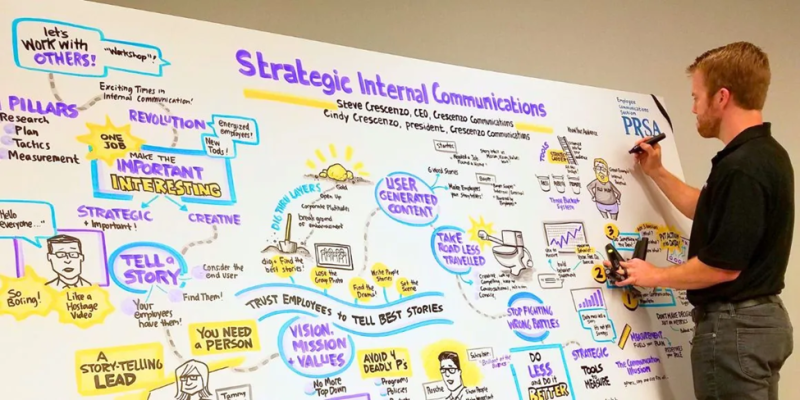
When a speaker steps onto the stage, the atmosphere in the hall often shifts to one of focused anticipation. The audience listens intently, aided by slides that accompany the talk, trying to retain as much information as possible.
Yet, off to the side, someone else is working with equal intensity. Standing by a large, illuminated board, she transforms the spoken words into live drawings. Her role may not be immediately clear, but her work captivates participants and provides a powerful visual summary of the event.
Why Graphic Recording Matters
When attendees know that a visual record of a presentation is being created, they can concentrate fully on listening instead of dividing their attention between taking notes and following the talk. This improves recall and strengthens the overall conference experience.
In addition, having a visual recorder present allows participants to glance at the evolving drawings, which capture the essence of the presentation in real time. The combination of spoken word and visual imagery makes the knowledge stick more effectively.
What This Practice Is Called
In English, this service is commonly referred to as graphic recording, though terms such as scribing, graphic harvesting, or graphic facilitation are also used.
Interestingly, terminology varies by region. For example, in some countries the word “graphic” is preferred, while in others “visual” is more common, leading to phrases like visual recording or visual facilitation. Regardless of the term, the concept centers on visually documenting and clarifying information as it unfolds.
The Ice-Breaking Role of Graphic Recording
At conferences, graphic recording often plays a valuable social role. During breaks, participants gather near the boards to take photographs, sparking conversations and creating an easy way to connect with one another.
Speakers themselves often enjoy seeing their ideas represented visually and may share the boards as mementos of their presentations. These images, capturing the “big picture” in a single view, help audiences grasp the full scope of discussions more effectively than multiple slides. After the event, high-quality photos of the boards allow attendees to revisit and remember the key points with ease.
A Short History of Graphic Recording
Pinpointing the exact origins of graphic recording is difficult, but the practice began to take shape in the 1970s. It quickly became clear that combining visual elements with spoken content improved group memory, understanding, and collaboration.
In recent years, interest in this method has expanded across many countries. Organizations have embraced visual documentation not only at large conferences but also for internal use, recognizing its ability to support effective communication and lasting engagement.
Graphic Facilitation in Important Meetings
Graphic facilitation differs slightly from recording alone. While recording captures content, facilitation uses visuals to support dialogue and guide discussions.
Companies often bring in a graphic facilitator during strategic or project meetings to address common challenges such as low engagement or unclear communication. By impartially documenting contributions in visual form, facilitators help participants feel heard, encouraging more active involvement. The visual summaries also allow teams to track progress, spark creativity, and clarify diverse perspectives.
Visual metaphors play a key role in this process. By representing abstract ideas with symbols, facilitators help bridge differences in interpretation. For instance, a symbol for success might mean financial achievement to one leader and customer growth to another. Through visuals, these perspectives can be reconciled and discussed openly, leading to better collective decisions.
Is Graphic Recording for Everyone?
Graphic recording is not typically used for every meeting, as it would be impractical and costly. Instead, it is reserved for moments when discussions carry significant weight or long-term consequences.
In such cases, the visual boards are often photographed and shared as summaries, ensuring clarity for those present and for others within the organization. Some companies even repurpose these visuals into creative formats such as calendars, notebooks, or other materials that reinforce the key messages.
Summary
Graphic recording can be applied in many ways, from large conferences to smaller, critical meetings. Over the past four decades, the practice has grown steadily, becoming increasingly relevant in today’s fast-paced world where information overload is common.
Professionally crafted visuals help audiences absorb content quickly, while adding a touch of creativity and energy to serious discussions. The adaptability of this approach means it continues to evolve, with new applications emerging through collaboration between recorders and clients. At its heart, graphic recording is about making ideas visible—and in doing so, making them more powerful.











Comments